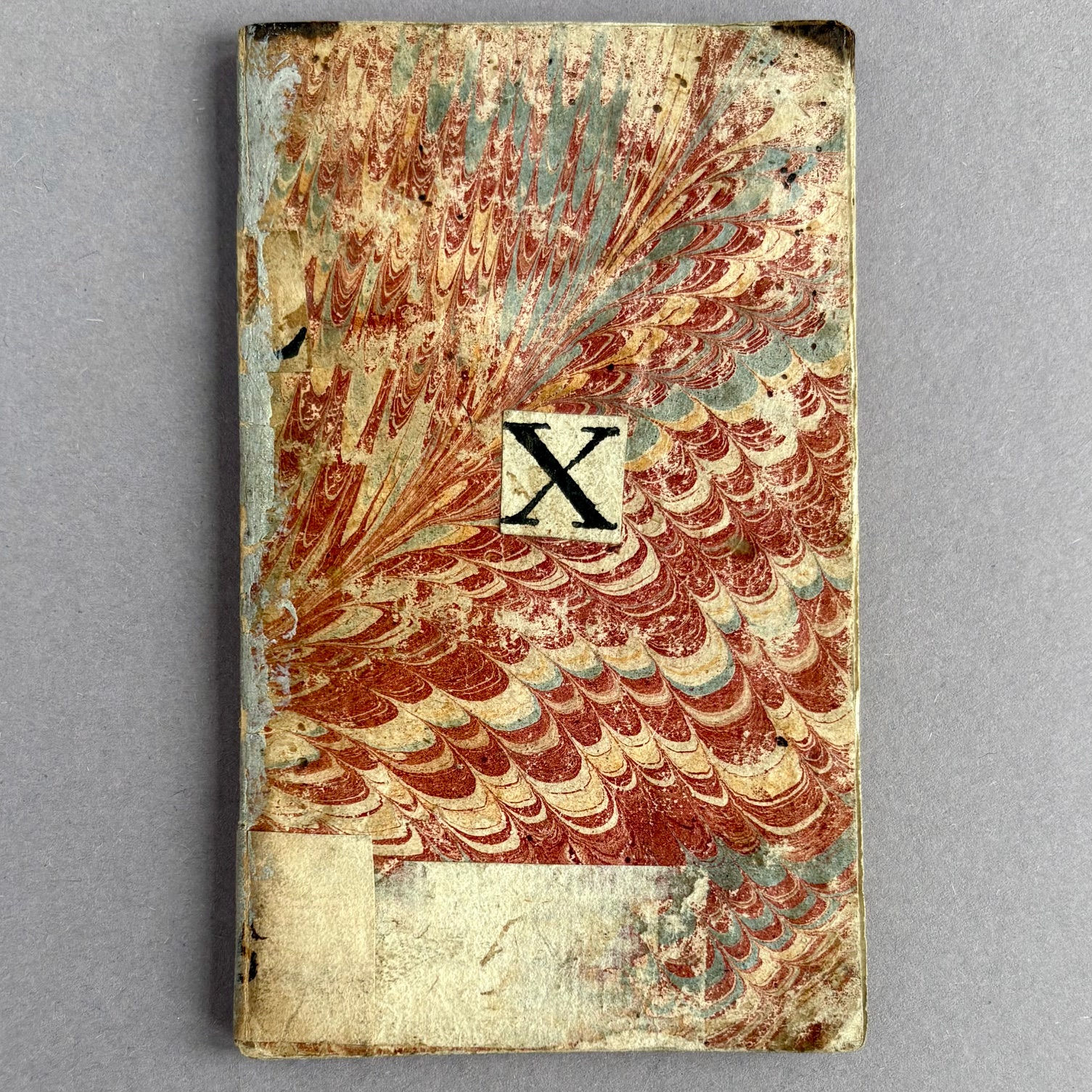

Scorning the world: pocket edition. No U.S. copies.
Bernard of Clairvaux. Sancti Bernardi Claravallensis abbatis Carmen paraeneticum ad Rainaldum F.L.A.O. Micro-Pragae: Typis Joannis Arnolti à Dobroslavina, 1673. 12mo [12.7 x 7.6 cm], [1] f. engraved portrait, [25] ff. Bound in contemporary marbled paper, all edges gilt, shelf-mark labels to spine and upper cover. Rubbing, staining and edge wear. Self-mark and stamp on back of engraving, ink stains to upper corners, mend to f. A12.
Very rare (no U.S. copies) 1673 Prague edition of the “Carmen paraeneticum ad Rainaldum,” a recently ‘rediscovered’ poem attributed to Bernard of Clairvaux (1090-1153) in which he addresses a young man about mortality and scorning the secular world in favor of spiritual matters. The pocket-size format of this edition suggests that the wisdom of the poem was thought worthy to be issued as a vademecum.
A Latin preface cites the 1663 edition (Rome: typis Mascardi) as the first edition and repeats that edition’s claim that the poem recently had been discovered in an old manuscript in the Chigi library. In fact, Bernard of Clairvaux is likely not the author of the poem, and the piece was long known as a medieval school text, being anthologized in such compilations as the Auctores Octo. Goldschmidt (colorfully) summarizes the history of the textual history of the “Carmen paraeneticum ad Rainaldum”:
“The Auctores Octo gradually developed as a convenient volume of Latin versified texts for schoolboys to interpret and to memorize; it can be traced back to the thirteenth century and continued in general use well into Erasmus of Rotterdam’s lifetime and beyond. It comprises the following eight pieces: Cato, Disticha; the Theodulus; the Facetus; the Floretus; Aesop (in verse); Mathieu de Vendôme’s Tobias; Alain de Lille’s Parabolae; and the De Contemptu Mundi, beginning:
“Chartula nostra tibi mandat dilecte salutes
Plura videbis ibi, si non haec dona refutes
Dulcia sunt animae solatia quae tibi mando
Sed prosunt minime nisi serves haec operando...
“This poem which dates from the twelfth century is usually found in manuscripts or in printed books either as anonymous or as the work of St. Bernard of Clairvaux. It is most conveniently found in the Patrologia latina of Migne, vol. clxxxiv, p. 1307, where it appears in an appendix of supposititious works of St. Bernard. It is characteristic of the general attitude of indifference to the bibliographical antecedents of such texts that Migne’s editor prefaces these verses with the remark: ‘... Non ergo ejus (i.e. S. Bernardi) esse putem carmen paraeneticum ad Rainaldum quod Petrus Possinus S.J. ex bibliotheca Chigiana Romae vulgavit anno 1563.’ [In fact, this is the 1653 edition mentioned above.] Not only did the nineteenth-century editor not care a straw whether this chance publication of 1563 had any claim to originality or priority, but the sixteenth-century Jesuit could publish the poem as a literary discovery within less than fifty years of the period when every schoolboy knew it by heart!” (pp. 29-30).
OCLC and KVK locate no U.S. copies of this ‘Micro-Prague’ edition, and the book is also very rare in European census.
*Ernst Philip Goldschmidt, Medieval Texts and Their First Appearance in Print, pp. 29-30.